
Announcing Runchat 0.5
A node based editor for automating your job

What is Runchat?
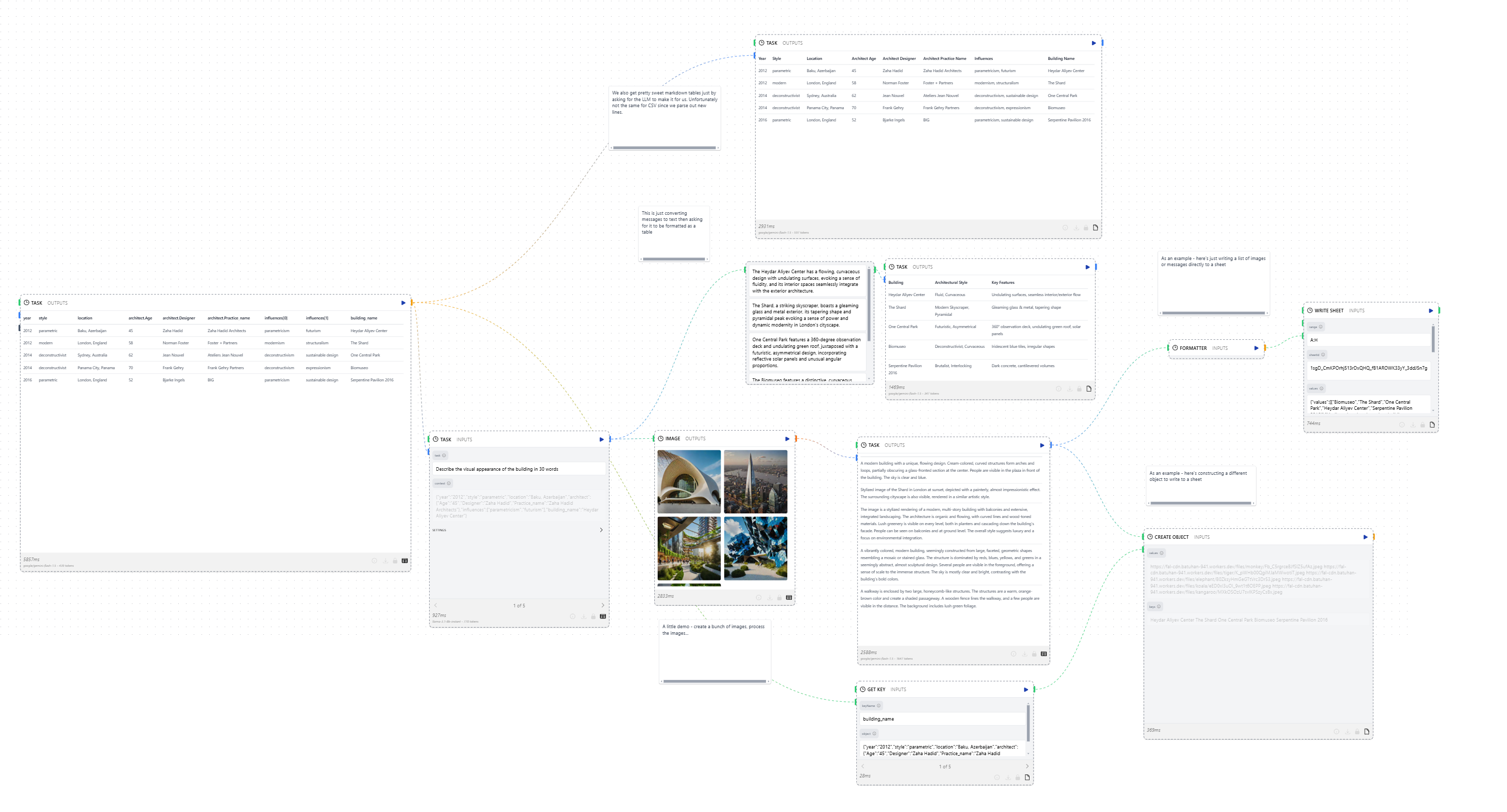
Runchat is a node based editor for building things with language models. It consists of 3 basic building blocks: a node for prompting language models, a node for making requests to external services, and a node for writing javascript code. You can connect these nodes together on a 2D canvas to make apps called runchats. Runchats can be:
Shared and embedded in other runchats to build up more powerful tools
Published as simple web apps that people can use without an account
Run on schedules to do jobs
Triggered from external services via api
Yeah, but what’s it for?
Runchat was initially conceived of as a tool for concept exploration by encouraging people to think systemically about prompts and their relationships rather than one-shotting chatGPT with requests like “come up with a totally unique idea for x”. And this is still broadly speaking Runchat’s goal: we want to help people use AI for creative good. Runchat helps people find creative ways to automate tasks and improve productivity. Runchat also helps people to be more creative with language models by sharing, connecting, remixing and refining generated content in creative ways.
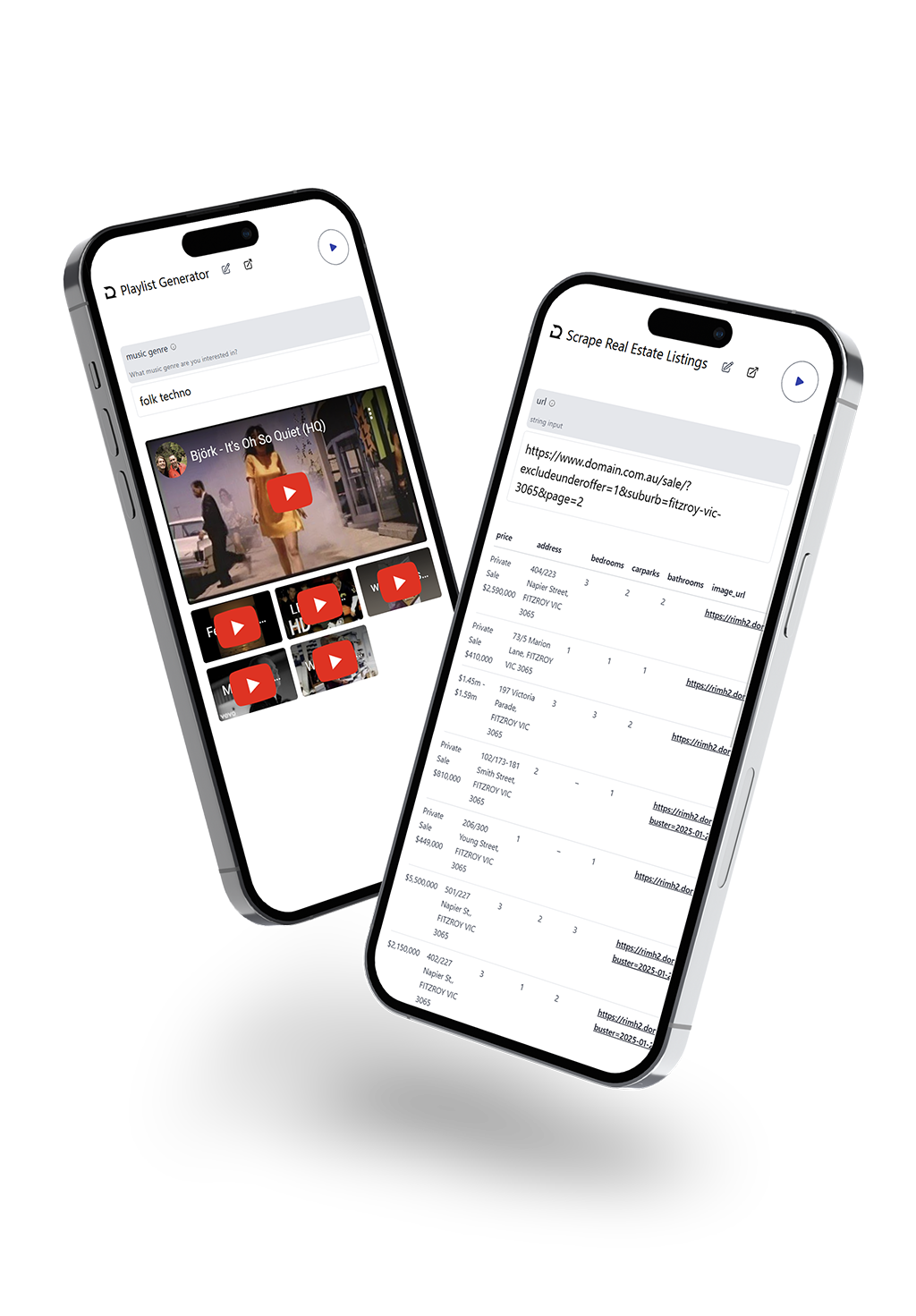
If you’re on the hunt for a new house, you could use Runchat to check the web for relevant properties and save them to a spreadsheet for you. Maybe you get creative and have a language model analyze trends and send you an email when something unusual pops out. You could make a Runchat that takes images of receipts and files them in Xero, or takes photos of food and suggests nearby restaurants with similar dishes. For fun, you could use Runchat to build an infinite trivia or role playing game with a state that can be returned to and played over time. Or an assistant that recommends new music each day based on an ongoing conversation about the listeners tastes. You can make a Runchat that refines itself as visitors interact with it, changes in response to live events, designs it’s own interfaces, writes games with emergent narratives and more.
Why try it?
It’s fun. Want to make an app that checks for cool new bars in your city? Go for it. Want to make a playlist generator for a party that everyone can suggest ideas for? That too. Just want to process some receipts and save them to a spreadsheet? Automate boring jobs and make time for more fun.
It’s fast. Really fast if you link Groq. Because Runchat is fast, you can define app logic by chaining prompts together rather than writing code (though you can do that too).
It’s flexible. Build a Runchat once, then use it as a tool in another Runchat. Prompts can use Runchat’s as tools too! It’s a bonanza.
It’s AI-first. Runchat is a great tool for exploring ideas for how to build automations and agents even with the limitations of current modeIs. We support structured outputs, function calling and automatic code generation.
It’s free. Link an OpenRouter account and use free experimental models in Runchat. We won’t charge you a thing. If you can’t be bothered or want access to some features that aren’t supported by OpenRouter, then there is a $19/month tier.
It’s functional. Automate something you don’t want to do. Or automate something you do want to do but don’t have time for.
It’s friendly. We put our email on the feedback form but if you want to talk on the phone about something we can do that too.
Why 0.5, or, what can’t it do?
We understand that Runchat isn’t a polished product. It’s maybe half a polished product. It needs some people to help show us what it can be, and what it really can’t or shouldn’t be. We’re experts at working with node based editors, and passionate about finding ways to be more creative and productive with technology. We have to admit that this can cloud our view on things sometimes, and it’s time to paint a more realistic picture of how people might work with Runchat. We think we can improve the following:
Node based editors can be tricky and opinionated. It’s not always obvious how they work or what their rules are.
Language models can be tricky and opinionated. Understanding when to use what model, how to structure outputs, how function calling works or even just how to write a good prompt is all something of an artform.
It’s hard to start an ecosystem. You can build something once in Runchat and share it with other people so they never need to reinvent the wheel. Over time, Runchat should become more useful. But for now it’s an empty playing field.
Most apps are for work or play, not both.
Because of this, we’re calling this an early release. Runchat is free to use for most features, so try it out and let us know what you think.
Still here? This is what we’re most proud of:
We’re really excited to keep runchat low cost, and this means finding ways to do more with smaller, cheaper language models and reducing the cost of running various automations on the cloud. Making runchat fast enough to run securely on a server, and integrating with OpenRouter helps make this possible.
One of the most powerful features of language models is their ability to run external tools. Runchat makes it really, really easy to create a tool and give it to a language model to use. You can even use these runchats as tools with language models that aren’t running on runchat, if you wanted to give us the snub like that.
Because any collection of nodes (a runchat) can also become a single node in another runchat, it makes it easy to abstract away complexity from users who might not want to deal with it. You can write some javascript (or get a language model to do it for you), then expose the inputs and outputs you want and turn it into a nice little node with no-one the wiser that it contains scary code inside.
Runchat has several basic building blocks for building high-agency automations. Runchats can run on a schedule to perform polling tasks or wait for a response from a slow data source (like a human replying to an email). Runchats can decide on their own when to use other runchats as tools. If you want a runchat to integrate with a third party service, you can paste in a cURL command from some docs and have runchat format the request for you to suit your data.
Using Runchat feels like you’re making something. It doesn’t feel like filling in a form. Because runchat is parametric, changing a prompt somewhere will immediately update everything that depends on it. This makes runchat fantastic for creative exploration, for rapidly iterating on ideas and their implications in parallel in a way that is difficult to do through a chat interface.
Thanks for reading. Try it out and let us know what you think — runchat.app